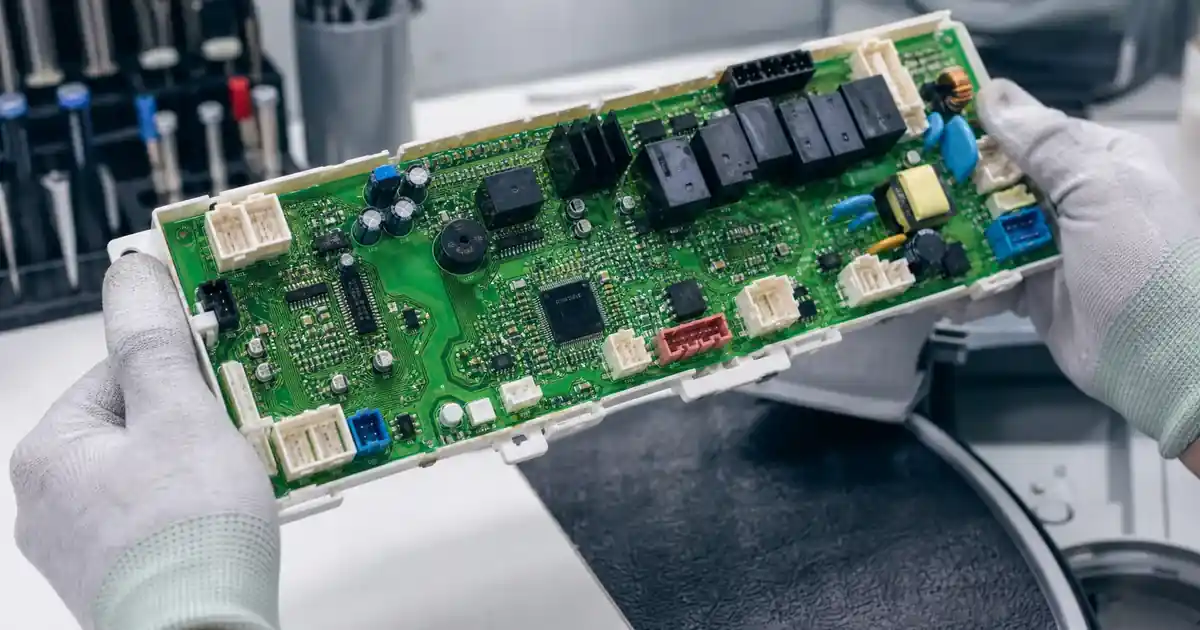
When a washing machine starts behaving strangely — buttons that don't respond, a cycle that stops halfway, a display flashing codes that don't seem to mean anything — people assume the whole machine is finished. Often what's actually failing is one part: the control board, the small circuit board that acts as the machine's brain. It's also one of the parts our Jamaican power supply damages most, which is why I want to explain it properly.
What the control board actually does
Every modern washing machine runs on an electronic control board. It's the part that reads your settings, tells the motor when to spin, the valves when to fill, the pump when to drain, and the lock when to engage. On inverter machines there's often a separate inverter board that drives the motor. When one of these boards starts to fail, the symptoms can be all over the place — because the board touches everything.
The signs of a failing control board
No single one of these proves it's the board, but when several show up together, the board moves to the top of my list:
- Unresponsive or erratic buttons — you press start and nothing happens, or the wrong function triggers.
- The machine powers on but won't start a cycle.
- Cycles that stop partway through for no clear reason.
- A flickering, frozen, or garbled display.
- Random error codes that don't point to one consistent part, or that change each time.
- Functions behaving out of sequence — filling when it should drain, skipping the spin, and so on.
The reason I look at the board only after ruling out simpler causes is that many of these symptoms can also come from a single failed component — a faulty lid switch stopping the spin, a blocked pump throwing a drain error. A good diagnosis separates "the board is confused because one part failed" from "the board itself has failed." Be wary of anyone who condemns the board on sight — it's usually the most expensive part, and it's the lazy thing to blame.
Why boards fail so often in Jamaica
Here's the part specific to us. Control boards are sensitive electronics, and they're designed for a steady power supply. Our supply is anything but. A voltage spike when JPS power is restored after an outage can fry components on the board in an instant — and I replace boards killed this way far more often than boards that simply wore out.
This is the strongest argument I know for protecting your machine. A surge protector or, better, a voltage stabiliser genuinely extends the life of the board, and it costs a fraction of what the board does. I explain exactly how this damage happens, and what protection actually works, in how power cuts and voltage spikes destroy your appliances. If you take one thing from this article, let it be that.
Can a control board be repaired or does it need replacing?
It depends on the fault. Sometimes a board has a specific failed component — a relay or a capacitor — that can be repaired, which is cheaper than a full board. Other times the board is too far gone and needs replacing. Part of a proper diagnosis is telling you honestly which it is, and whether — on an older machine — the board cost has tipped the balance toward replacing the machine instead.
When to call
Control board faults aren't a DIY job — they involve mains electronics and careful testing to confirm the board is genuinely the problem and not an innocent part downstream. If your machine is showing the scattered, doesn't-add-up symptoms above, that's the time to call.
I diagnose board and inverter faults across Kingston, Portmore, Spanish Town and the surrounding communities, and I'll always check the cheaper causes first. Get in touch and let's find out whether it's really the board — and if it is, how to stop the next one going the same way.
Frequently asked questions
Unresponsive buttons, a machine that powers on but won't start, cycles that stop partway, a flickering display, or random error codes that don't match any single part. When several odd symptoms appear at once, the board is a prime suspect.
Our power instability is the biggest reason. A voltage spike when JPS power returns can damage the sensitive electronics on the board. Protecting your machine with a surge protector or stabiliser genuinely extends the board's life — see my guide on voltage spikes.
Oshane founded Baytech Repairs and Installation and still does the repairs himself. He has spent years fixing washing machines, fridges, dryers and stoves in homes across Kingston, St. Andrew and St. Catherine. He writes these guides to help fellow Jamaicans get more life out of the appliances they already own — and to know when a problem is worth a call.