Here's something that might surprise you coming from a repair man: I lose a job every time I tell a customer to replace their appliance instead of fixing it. And I still do it, regularly, because the alternative — taking someone's money for a repair that doesn't make sense — isn't a business I want to run. The trust is worth more than the one job.
So let me share the actual thinking I use when a customer asks me the hardest question in this trade: "Is it worth fixing, or should I just buy a new one?"
The simple rule of thumb
There's a guideline that works well as a starting point, sometimes called the 50% rule:
If the repair will cost more than half the price of a comparable new appliance, and the unit is past two-thirds of its expected lifespan, replacement usually makes more sense. Below those thresholds, repair almost always wins.
It's not a law, but it's a sensible frame. A $15,000 repair on a $60,000 machine that's three years old? Fix it without hesitation. That same repair on a twelve-year-old machine that's already been patched twice? Now we're talking.
How long appliances should last
To use that rule, you need a realistic sense of lifespan. Here's what I generally expect, bearing in mind our conditions can shorten these:
- Washing machines: 8–12 years
- Refrigerators: 10–15 years
- Dryers: 10–13 years
- Stoves and ovens: 13–15 years
I add the caveat about our conditions deliberately. Jamaica's heat, humidity, and especially our unstable power supply can take years off these figures. A fridge that might run fifteen years on clean, stable power elsewhere may give you ten here. That's worth factoring in.
The questions I actually ask
Beyond the rule of thumb, here's the fuller checklist I run through with customers.
What exactly has failed?
This matters enormously. A failed relay, thermostat, fan, or filter is a cheap, sensible repair on almost any unit. A failed compressor, a cracked drum, or a burnt main control board on an older machine is often the moment to walk away. The part that failed tells you most of what you need to know.
How old is it, honestly?
Not "it doesn't feel that old" — the actual age. If you don't know, the model and serial number usually date it. An appliance in the first half of its expected life is almost always worth repairing.
Has it been reliable until now?
A machine that's served faithfully for years and hits one fault is a different case from one that's been in and out of repair. If I've already fixed two other things on it this year, a third fault is a pattern, and patterns on old machines point to replacement.
What's the energy cost?
A very old fridge running constantly can cost real money on your light bill. Sometimes a newer, efficient unit pays back part of its price in savings — worth weighing if the old one was a power-hungry model.
Can you get the part?
For most brands and faults, yes. But for very old or obscure units, parts can be discontinued. If a part can't be sourced, the decision makes itself.
When repair almost always wins
- The appliance is in the first half of its life.
- The fault is a common, inexpensive part.
- It's been reliable until now.
- It's a quality unit that would cost a lot to replace like-for-like.
When replacement usually wins
- The repair approaches half the cost of a new comparable unit.
- The unit is past two-thirds of its lifespan.
- It's a major component — compressor, motor, cracked tub — on an old machine.
- It's already been repaired multiple times recently.
- Parts are discontinued.
The thing most people get wrong
The biggest mistake I see isn't choosing wrong between repair and replace — it's waiting too long to ask the question at all. People run a failing appliance into the ground, ignoring the noises and warning signs I talk about in my maintenance guide, until a small repairable fault has cascaded into a major one. By the time they call, the cheap fix window has closed and they're forced into replacement. Catching things early keeps the repair-or-replace decision firmly in "repair" territory far longer.
How I can help
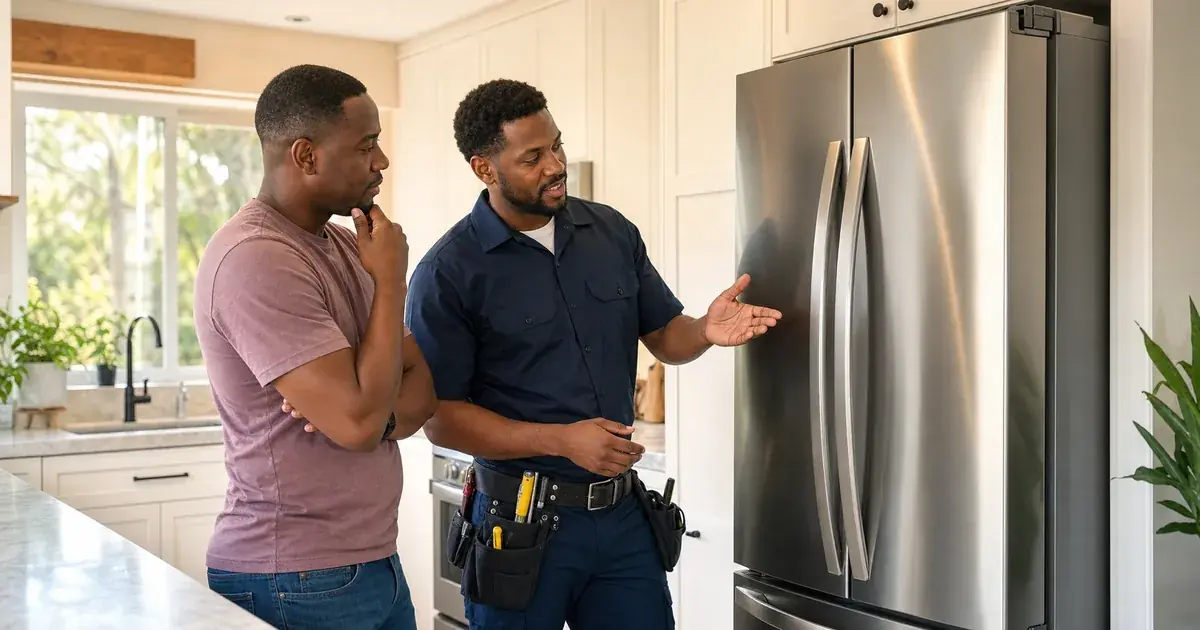
When I diagnose an appliance, I don't just tell you what's wrong — I tell you what the repair costs, roughly what a comparable replacement costs, and which way I'd lean if it were my own home. Then the decision is yours, made with real information instead of a guess. Sometimes that means I fit a part and you're sorted for years; sometimes it means I tell you to put your money toward a new one. Either way, you'll get a straight answer.
If you're weighing up an appliance anywhere across Kingston, Portmore, Spanish Town or nearby, get in touch. I'll give you the honest math.
Frequently asked questions
A common guide: if the repair costs more than half the price of a comparable new unit, and the appliance is past two-thirds of its expected life, replacement usually wins. Below that, repair almost always makes sense.
Roughly: washing machines 8–12 years, fridges 10–15, dryers 10–13, stoves 13–15. Our heat, humidity and power instability can shorten that, which makes protection and maintenance especially worthwhile here.
Oshane founded Baytech Repairs and Installation and still does the repairs himself. He has spent years fixing washing machines, fridges, dryers and stoves in homes across Kingston, St. Andrew and St. Catherine. He writes these guides to help fellow Jamaicans get more life out of the appliances they already own — and to know when a problem is worth a call.